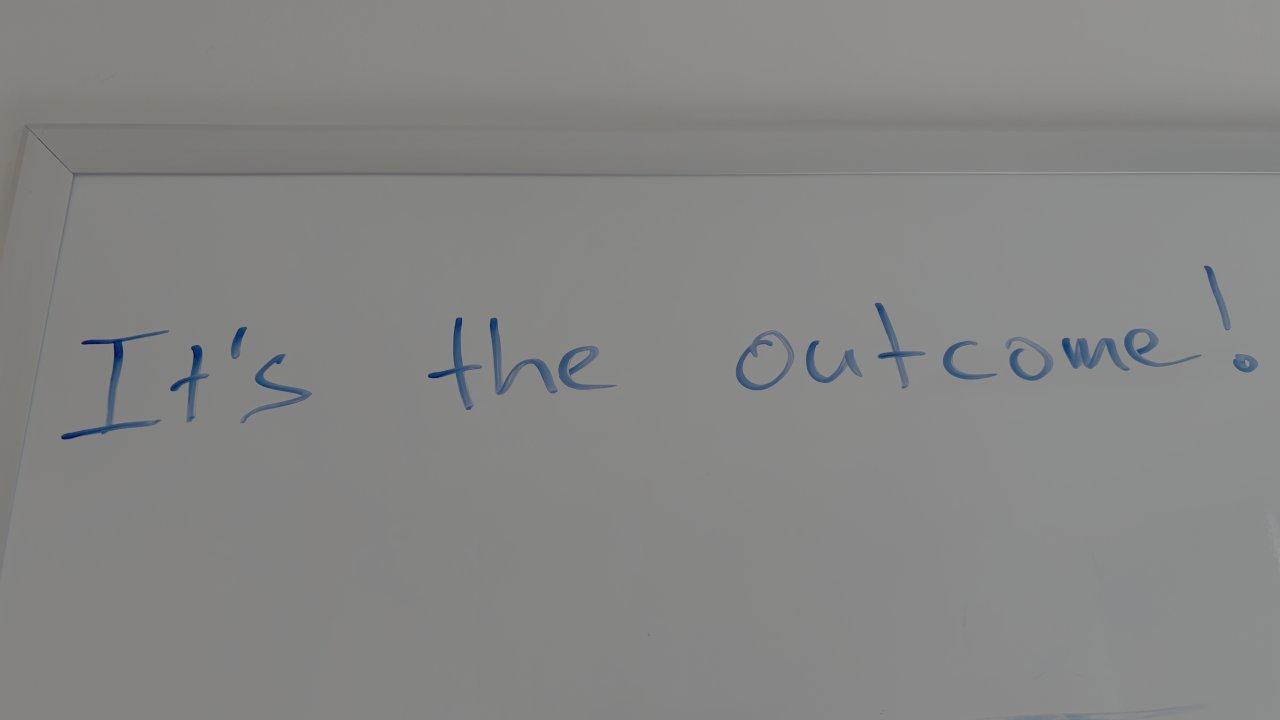
In 1992, James Carville posted three words on a whiteboard in a Little Rock campaign office. "It's the economy, stupid." Not for the public. For the team. A reminder to stay focused on what actually matters. The campaign had one metric. Everything else was noise.
Most executives running AI initiatives need a similar reminder on their wall.
Most AI programs I see are measured the wrong way. They report activity metrics. How many tools deployed, how many employees trained, how many use cases in production. They tell you what your team did. They tell you nothing about whether the business moved.
Here is the question that actually matters: did revenue go up, did margin improve, did the customer experience get better? And what still needs to happen to realize the full gain?
If you cannot answer that directly, your AI program is not a business program. It is a technology program. And technology programs, no matter how well run, do not get the attention, funding, or staying power that business outcomes do.
Let me make this concrete
A sales team gets an AI tool. It analyzes pipeline data, historical win rates, deal characteristics, and customer behavior. Each rep receives an individual, actionable list: which deals are most likely to close, and which ones are quietly dying that nobody is talking about.
Then it goes further.
Using historical sales performance, it predicts win probability at different price points. At $600K this deal has a 75% chance of closing. At $575K it jumps to 95%. Now the conversation shifts. The rep and manager are making a conscious decision: do we protect margin, or do we take the higher-probability close? That is a business decision, made with data, in real time.
The reps stop spending Monday morning on accounts that feel comfortable. They start spending it on accounts that are actually winnable this quarter. The manager stops guessing in forecast calls. The VP of Sales has a number she trusts.
That is not an AI story. That is a revenue story. AI creates signals that change behavior, and changed behavior drives measurable outcomes.
I have seen this lift sales by high single digits. More importantly, it brings the majority of reps close to the performance level of your top performers. You are not just improving the average. You are scaling what good looks like across the entire team.
The mistake most leaders make
The mistake most leaders make is measuring the input, not the result. They report to the board on deployment. Tools rolled out, users trained, processes automated. The board nods. Nobody asks the question that matters: what did we actually win because of it?
Work backwards. Start with the business outcome you need. Revenue growth, margin improvement. Then ask: what decisions, processes, or bottlenecks stand between you and that outcome? Then ask: where does AI remove those bottlenecks faster, more reliably, at scale?
That sequence matters. Most organizations run it in reverse. They deploy AI and then look for outcomes to attribute to it. That is how you end up with a lot of activity and not much to show for it.
Operators, not technologists
The leaders who get this right think like operators, not technologists. They are not asking "how do we become an AI company." They are asking "how do we grow revenue, and what role does AI play in that?"
The technology is a tool. The outcome is the job.
Get clear on what you are trying to win first. Everything else follows.
What outcome are you building toward? And how are you measuring it?