Most organizations don't fail at product thinking because they lack vision.
They fail because they try to jump straight from project chaos to Spotify-style squads.
And it never works.
Here's what actually happens
You are running 40-100 active projects. Everything is labeled "top priority." Your IT team context-switches every 2-3 weeks. Business leaders optimize for their silos. Funding happens annually, re-planning happens quarterly. Success is measured by delivery, not impact.
Then someone goes to a conference, reads Empowered, or hires a consultant.
The message: "transform to product teams."
So you do. You create squads. You rename project managers to product owners. You talk about OKRs and value streams.
Six months later, nothing has changed on the P&L.
The squads are just project teams with new titles. Business leaders still treat IT like an order-taking function. Priorities are still set through escalation meetings. The only difference is everyone's confused about who owns what.
You can't jump from project chaos to product mastery. There's a middle phase. It's messy, imperfect, and uncomfortable. Most transformation playbooks skip it entirely. That's exactly why most transformations fail.
The three-phase reality that actually works
If you want to move from projects to products without breaking the business, here's the progression that works.
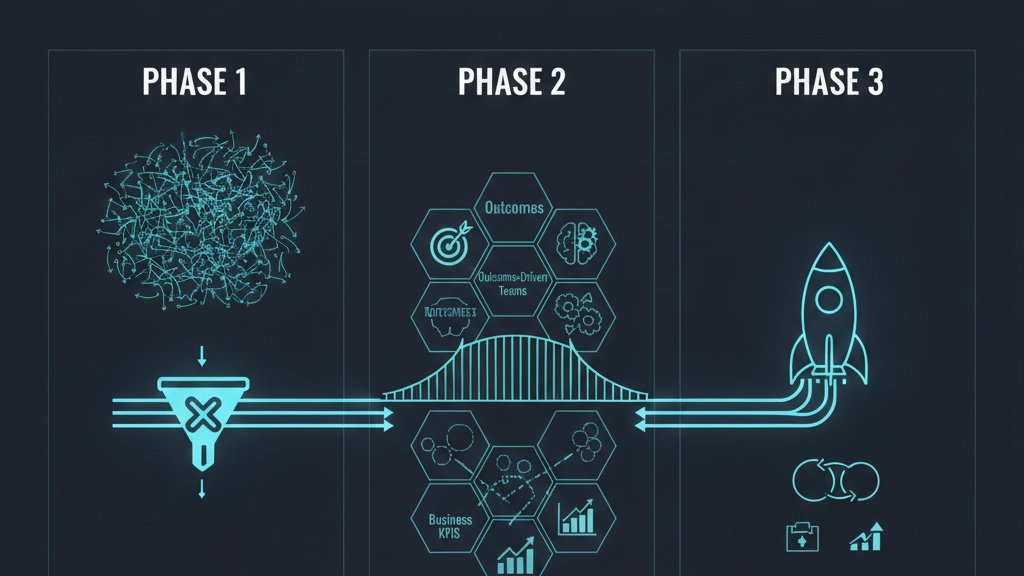
Phase 1: ruthless focus before product teams
You don't start by reorganizing IT into squads.
You start by forcing the executive team to agree on 3-5 enterprise priorities.
Not 40 priorities. Not 12. Three to five.
Everything else becomes explicitly secondary. Not "we'll get to it later." Not "let's keep it on the backlog." Secondary means: we're not funding it, we're not staffing it, we're saying no.
This is where most CIOs fail. They try to keep everyone happy. They hedge. They say "yes, but later" to 30 initiatives while trying to transform 5.
You can't transform while maintaining project chaos.
The work in Phase 1 is concrete. Build one enterprise backlog and kill the competing roadmaps. Make trade-off decisions visible to the entire organization. Co-own prioritization with business leaders, not IT alone. Kill projects mid-stream when they don't align to the 3-5 priorities.
Yes, kill them. Mid-stream. Even if they're 60% done. Because if they don't drive the enterprise priorities, they're waste.
This takes 6-9 months. It's politically exhausting. Some business leaders will opt out. Let them.
The companies that succeed have CEOs who hold the line. The ones that fail have CIOs who try to do transformation AND keep everyone happy. You can't do both.
Phase 2: outcome-driven teams (the unsexy middle)
Once you have focus, you don't immediately create product teams.
You create outcome-driven teams.
These aren't product teams yet. They're hybrid. Small, stable teams, still with imperfect funding models, still with mixed skill maturity, but with one critical difference: they're not given task lists. They're given outcomes.
Not: "Build this feature by Q3."
Instead: "Increase conversion rate by 20% over the next two quarters."
Not: "Migrate to the new platform."
Instead: "Improve time-to-insight for commercial teams by 30%."
The teams own the outcome. They figure out how.
In Phase 2, you're still figuring it out. Product managers might be part-time initially. Business SMEs are embedded in teams, not "stakeholders" who show up to demos. Governance shifts from approval gates to outcome reviews. Metrics shift from velocity to business KPIs.
This is the unsexy middle. Your org chart still looks mostly traditional. Your funding model is still evolving. Half your teams are crushing it, the other half are still figuring out what "outcome-driven" actually means.
You're not Instagram-ready. You won't win awards. But this is where the transformation actually happens.
Phase 2 takes 6-12 months. You'll know it's working when business leaders stop asking for features and start asking "how do we move this metric?"
That's the signal.
Phase 3: true product teams
Only after you've done Phase 1 and Phase 2 can you get to product teams.
Now the structure changes. Durable teams aligned to value streams, not projects. Clear product ownership with P&L accountability. Funding moves from annual projects to continuous products. Roadmaps become hypotheses, not promises.
Now the culture changes. Business leaders stop "requesting features" and co-own outcomes. Teams own end-to-end, no more "we built it, ops runs it." Technology becomes a growth lever, not a constraint. The CIO shifts from delivery executive to capital allocator.
This is the end state everyone talks about.
But here's the reality: this took quarters, not months. Not every area moved at the same speed. Some leaders opted out entirely, and that's okay.
You don't need 100% adoption to see P&L impact. You need focus on the 3-5 things that matter.
What this actually requires from the CIO
This isn't a tooling change. It's not a reorg. It's a leadership shift.
Your job in Phase 1: Hold the line on priorities. Translate enterprise strategy into team-level clarity. Say "no" publicly and repeatedly.
Your job in Phase 2: Protect teams from thrash. Teach business leaders how to define outcomes, not requirements. Sit with teams when their "product backlog" is still just a list of tasks.
Your job in Phase 3: Debate capital allocation with the CEO. Orchestrate how technology investments map to P&L outcomes. Operate at 30,000 feet, but know when to go deep.
Some weeks you're in the boardroom talking about how technology drives competitive advantage. Other weeks you're with a team untangling why their outcome isn't moving.
Both matter.
Why most articles skip the middle
Product operating models look elegant on paper. Autonomous squads. Value stream alignment. OKRs. Clear ownership. It all makes sense.
But the path from here to there is messy. You're funding teams while projects are still finishing. You're teaching product thinking while some leaders still want Gantt charts. You're measuring outcomes while your systems still report on delivery.
It's contradictory, uncomfortable, and slow. That's why most transformation playbooks skip it.
They show you the before (project chaos) and the after (product utopia), but not the middle.
The companies that succeed live in the middle. They understand that transformation happens in phases, not flips. They know that some discomfort is required, but total chaos isn't. They understand that you can't rip out the existing operating model while the business still depends on it.
The unsexy middle is where transformation succeeds or dies. Most CIOs avoid it because it's not impressive to talk about. The best CIOs embrace it because it's the only path that works.
The bottom line
If your organization is drowning in projects, don't jump to product teams.
Start with Phase 1. Ruthless focus. Kill the chaos. Align on 3-5 priorities.
Then Phase 2. Outcome-driven teams. Teach the organization how to measure impact, not activity.
Only then Phase 3. True product teams.
It takes years. It's uncomfortable. Not everyone will come along.
But it's the only way to move from project chaos to product impact without breaking the business.
And that unsexy, patient, pragmatic middle? That's exactly what separates transformational CIOs from expensive consultants with slides.